


Actuarial work is full of repeated methods. Teams validate data, apply documented assumptions, reproduce calculations, investigate movements, prepare evidence and route judgements for review. Yet the method behind that work is often distributed across prior files, process notes, templates, local conventions and the memory of experienced colleagues.
This is an awkward foundation for AI-assisted work. A large language model can interpret documents and generate plausible analysis, but it cannot infer private requirements it has never seen. If each user supplies a fresh prompt and a handful of old outputs, the model must reconstruct the process for every task. Variation in the prompt, source material or model can then produce variation in the method.
The problem is not simply that organisations need better prompts. They are preserving the outputs of professional work while leaving much of the procedure that produced them implicit. A completed report records what was concluded. It rarely records every data check, exception, escalation point and review decision needed to reach the conclusion reliably next time.
Agent Skills offer a practical way to make that procedure explicit. They package reusable instructions and supporting resources so that an agent can perform a defined piece of work. The open format was originally developed by Anthropic and is now documented as a shared specification used by several agent products.
This article hypothesises that agent skill packages are an essential layer of actuarial infrastructure. They can connect capable general models with the methods, controls and organisational context required for accountable work. Their value does not come from removing professional judgement. It comes from making the repeatable part of the method inspectable, testable and available before judgement is exercised.
This is the first of five articles. The second examines how completed work can become reusable packages. The third introduces SkillOps as the discipline for governing agent skill packages in actuarial work. The fourth considers the consequences for consulting when expertise previously carried through human capital is codified in reusable agent skill packages and becomes intellectual property. The fifth places skills within the wider challenge of continual learning.
From prompt engineering to agent skills
A trusted authority on skills. Napoleon Dynamite (2004).
Prompt engineering is the practice of designing instructions that help a model perform a task. Agent skills take the next step: prompts can be one component of the package, but they are not the whole package.
At its simplest, the open Agent Skills specification defines a skill as a folder containing a SKILL.md file. That file begins with a name and description, which help a compatible agent decide when the skill is relevant. Instructions for carrying out the task follow. The package can also include executable scripts, reference material, templates, examples and evaluation cases.
The format does not require fine-tuning or other changes to model weights. Instead, the process can be described in inspectable files and connected to the resources the agent needs.
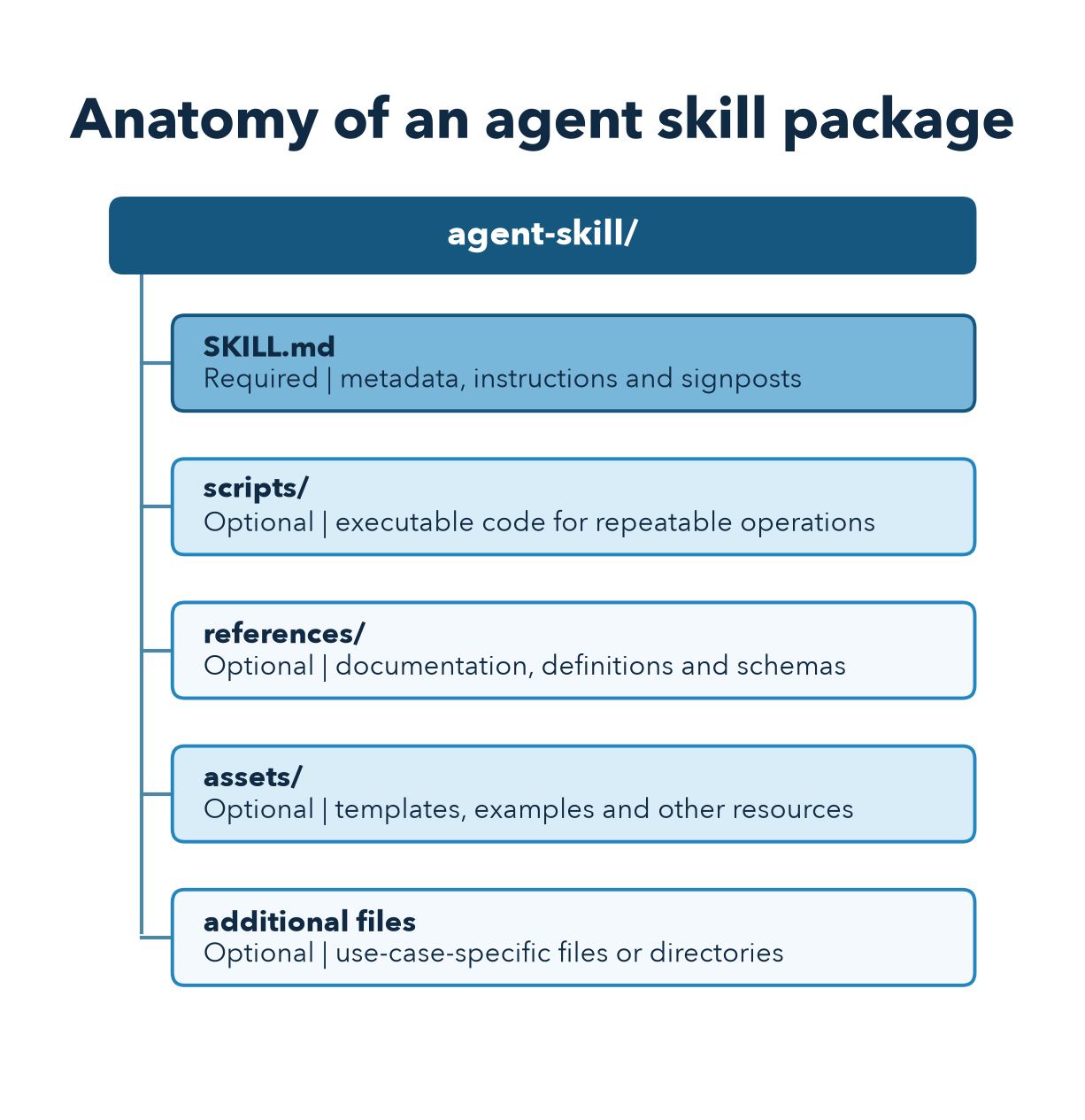
Figure 1. A generic agent skill package. One required SKILL.md file can signpost optional supporting resources. All supporting directories and additional files are optional; what the package includes depends on the nature of the skill.
Consider an illustrative skill supporting the roll-forward of a reserving audit. Its package might contain:
SKILL.md, setting out the scope, required inputs, sequence of work, review gates, expected outputs and conditions for escalation;scripts/, with deterministic routines to validate claims triangles, reconcile source totals, reproduce specified calculations and flag exceptions;references/, containing the audit methodology, data schemas, definitions, control criteria and relevant accounting or actuarial guidance;assets/, containing workpaper templates, evidence-request lists, issue logs, report formats and worked examples; andadditional files containing representative test cases and expected results.
The package would not replace professional judgement or audit sign-off. It would make repeatable procedures, calculations and supporting resources explicit. An agent could then execute them consistently and present the resulting evidence for review.
More than a long prompt
A sufficiently long prompt could attempt to describe every instruction, exception, client convention, schema and output format that might be needed. In practice, it would consume context with material irrelevant to the immediate task and could make the important instruction harder to find.
Agent skills use progressive disclosure to avoid that problem. The Agent Skills overview describes three stages: discovery, activation and execution. A compatible agent first sees each skill’s name and description. When a task matches, it activates the skill by loading SKILL.md, then reads or runs supporting resources only when the task requires them.
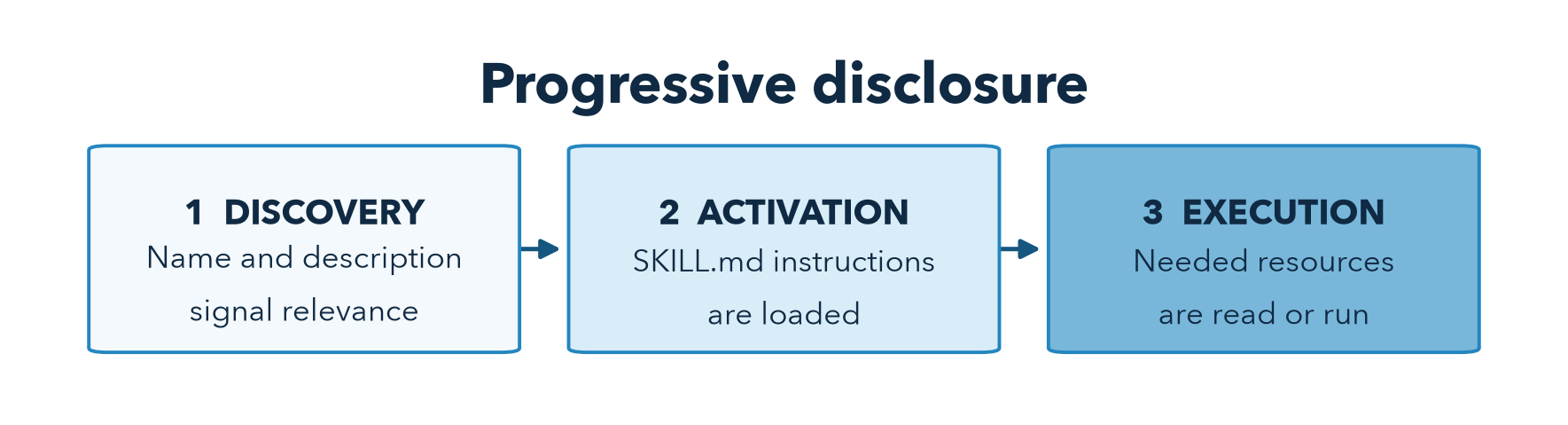
Figure 2. Progressive disclosure moves from discovery through the skill’s name and description, to activation through SKILL.md, then execution using only the resources needed for the task.
In the reserving-audit example, the agent need not load every process note, schema or worked example. SKILL.md could direct it to the triangle-validation script, the relevant schema and the required workpaper template. The package can hold more procedural knowledge than would sensibly fit in one prompt while keeping the active context focused.
Executable scripts provide a further advantage over long prompts. They allow fixed operations to be implemented in deterministic code rather than described for the model to reproduce through token generation. Where a reconciliation or schema check follows fixed rules, the agent can run the relevant script. Its output can enter the context without loading the entire implementation.
Together, selective loading and deterministic execution explain why an agent skill package is more than a long prompt. Instructions remain central, but they can direct the agent to the right code, references and assets at the right time.
The missing method in actuarial reuse
Actuarial teams already reuse a great deal. They roll forward spreadsheets, copy prior reports, maintain model libraries, store methodology papers and ask experienced colleagues how unusual cases were handled. Each practice is rational, but none necessarily preserves the whole method.
Copying an output can reproduce a result without revealing which steps were essential. A process document can describe the official method while omitting practical exceptions. A model can reproduce calculations without explaining how inputs were selected or how results should be challenged. An experienced actuary can supply the missing context, but that makes the process depend on their availability and memory.
Ad hoc prompting does not resolve this fragmentation. It often transfers the burden to the user, who must assemble the right context and explain the procedure again. The resulting prompt may work once yet remain invisible to colleagues, untested on alternative cases and disconnected from the controls governing the underlying work.
An agent skill package changes the unit of reuse. Instead of preserving only a report, workbook or conversation, the organisation can preserve a versioned procedure that points to authoritative sources and deterministic tools. The package can state what the agent should do, what it must not do, what evidence it should produce and when it should stop for human review.
This creates a middle layer between general model capability and a fully engineered application. It is lighter than building bespoke software for every professional workflow, but more explicit than hoping a model reconstructs the method from examples. It can also separate stable procedure from changing inputs, assumptions and client circumstances.
The distinction matters because actuarial quality is not located in one artefact. It emerges from the relationship between data, models, assumptions, controls, communication and judgement. A package can connect those components without pretending that they all belong inside model weights or one enormous prompt.
Commodity and organisation-specific components
Agent skill packages often combine commodity and organisation-specific components. Commodity elements are broadly available and likely to diffuse. A generic skill might explain how to create and edit a Microsoft Word document. That capability is useful, but it is not distinctive to one organisation.
Organisation-specific elements depend on a firm’s data, methods and obligations. A firm-specific reporting skill could use the organisation’s document template, approved terminology, metadata requirements, evidence standards and review pathway. A reserving skill could point to controlled data definitions, methodology decisions and escalation criteria.
The two kinds of component therefore require different maintenance questions. For a commodity element, ask whether the package still adds value beyond the current model and tools. For an organisation-specific element, ask whether it still represents the firm’s requirements correctly.
Integration with an institution’s processes and accountability machinery gives organisation-specific elements their value. It also means they warrant deliberate ownership and control, which the third article develops.
Agent skill behaviour drift and over-scaffolding
Commodity and organisation-specific elements may not retain their value at the same rate. As models internalise more generic knowledge and best practice, some commodity guidance may become redundant or constraining. Models still cannot infer private requirements they have never seen.
Here, agent skill behaviour drift means that an unchanged package can affect performance differently after a change to its model, model version or agentic harness. The agentic harness is the surrounding runtime that selects context, exposes tools and manages execution. The value contributed by a package can therefore change even when the task remains important.
An illustrative example comes from an Agent Skill I created to build Microsoft PowerPoint presentations. Its initial version drew on public material and open-source skills. It included generic heuristics, detailed process instructions and Python utilities. The package was then extended with firm-specific templates, style guides and review gates.
As base models and agentic harnesses became more capable, some instructions that had once prevented mistakes began to slow the work or conflict with better native behaviour. In later tests, some generic heuristics no longer produced a noticeable improvement. These were practical observations rather than a controlled benchmark.
Informal tests also showed different behaviour across model families. With the harness and skill otherwise unchanged, some heuristics introduced for one model conflicted with behaviour already embedded in another. The package had become tuned to one model family.
The organisation-specific resources behaved differently. Models could learn general presentation practice from training and product improvements. They could not infer a private template, internal visual convention or business-specific review gate they had never seen.
The package was therefore simplified by removing generic instructions that no longer improved the output while retaining the firm-specific templates, conventions and review controls. This is one case rather than market-wide evidence. It nevertheless illustrates why useful packages require deletion and compatibility testing as well as accumulation.
That accumulation of guidance a more capable model no longer needs is over-scaffolding. It adds maintenance and review cost without improving the result, so a useful package needs deletion as well as addition.
The same mechanism matters more in actuarial work. A model upgrade could improve generic analysis while changing how an agent interprets an exception, selects a reference or explains uncertainty. A package should not be retained merely because it once improved the process. It should continue only where evidence shows that it adds quality, efficiency or control against the current baseline.
It could be argued that routine portfolio governance will outperform static “write once” approaches. Some organisations may maintain fewer but richer organisation-specific packages while relying on base models for commodity tasks. That expectation should be tested against a no-skill baseline.
Actuaries as authors of reusable methods
Agent skills could widen participation in capability development rather than confining it to software engineers. A reserving actuary, pricing specialist or capital modeller can describe a recurring workflow, identify authoritative sources and show examples of acceptable and unacceptable outputs.
Platform tools can help turn that input into a draft package and evaluation cases. The second article considers routes for building reusable skills. The result should enter a reviewable repository rather than silently changing a production agent. Domain specialists remain responsible for whether the procedure represents the work accurately. Platform, security and risk specialists remain responsible for the controls around execution.
This division of labour is important. An actuary need not become a machine-learning engineer to make a method reusable. Equally, technical convenience does not transfer professional accountability to the model or platform team.
The opportunity is to make expert contribution cumulative. When a reviewer identifies a missing exception, the organisation can decide whether to improve the package and its tests. The learning then becomes available to the next authorised user without relying on everyone hearing the same explanation.
Process knowledge as infrastructure
The actuarial profession has become good at preserving finished artefacts. It retains models, workpapers, reports, policies and review records. These are necessary, but they often capture the result more clearly than the method that produced it.
That gap creates repeated work. Teams reconstruct procedures from last year’s files, rediscover local assumptions and ask experienced colleagues to explain why a control exists. When generative AI is added to this environment, it can accelerate the reconstruction. It can also accelerate inconsistency, because the model receives a different fragment of the method each time.
Agent skill packages address that specific failure. They allow the repeatable method to become an explicit asset: versioned instructions linked to controlled references, deterministic calculations, templates, examples and tests. Progressive disclosure makes that asset usable without loading everything into every task. Compatibility testing and deliberate retirement prevent yesterday’s workaround from becoming tomorrow’s hidden constraint.
This does not automate accountability. A package cannot decide whether an assumption is professionally defensible, accept material uncertainty or sign an actuarial opinion. It can make the route to those decisions more consistent and expose the evidence that a person must review.
The profession already governs models, data, assumptions and communications. It now needs to recognise the procedural layer through which AI agents connect them. Leaving that layer inside personal prompts and inherited files is itself a choice, and it makes important methods harder to inspect, challenge and improve.
The choice is not between human expertise and codified procedure. It is between expertise that must be reconstructed task by task and expertise that can be inspected, tested and improved before the next task begins.
The next article examines how documents, examples, conversations and existing skills can become reusable packages.
Recommended reading
For readers who would like to learn more about Agent Skills and how to create them, these online resources provide a route from the open format to practical implementation:
The Agent Skills overview introduces the format, progressive disclosure and the growing range of compatible products.
The Agent Skills quickstart walks through the creation and use of a first skill in VS Code.
The Agent Skills specification defines the required
SKILL.mdstructure, metadata fields, optional resources and validation rules.Anthropic’s engineering introduction to Agent Skills explains the architecture, the role of executable code and an evaluation-led approach to development.
Anthropic’s Skill authoring best practices covers descriptions, progressive disclosure, workflows, scripts, testing and common anti-patterns.
The Anthropic Skills repository contains a basic template and examples ranging from focused instructional packages to document-creation skills.
OpenAI’s Build skills guide explains how ChatGPT and Codex discover, create and distribute skills based on the open format.
The OpenAI Plugins repository provides maintained examples of distributable packages that combine skills with optional tools and other resources.
Microsoft’s Use Agent Skills in VS Code guide covers creating, generating, sharing and invoking skills with GitHub Copilot.